
CRM Integration Services
Looking for CRM integration services that finally get your CRM sharing data with the rest of your stack? SuvoCRM provides the API, connector, and middleware work that wires your CRM to the systems around it, including ERP, email, billing, support, and marketing tools, on platforms like Salesforce, HubSpot, and Dynamics 365. Show us the systems that refuse to talk, and we connect them.
What Are CRM Integration Services?
CRM integration services keep your CRM and the rest of your software in constant sync, so a record updated in one place updates everywhere it matters. The work means building and running the APIs, connectors, and middleware that move contacts, orders, invoices, and tickets between the CRM and the tools your business depends on.
Our specialists wire the CRM to your ERP, email, billing, support, marketing, and data warehouse, then hold each link healthy as those systems evolve. A connection that breaks without notice is worse than no connection, so the job runs past the first sync and into the daily upkeep.
The aim is one reliable version of the truth. When each system reads one identical customer record, your reps stop reconciling spreadsheets and your reports stop arguing with one another.
Our CRM Integration Services
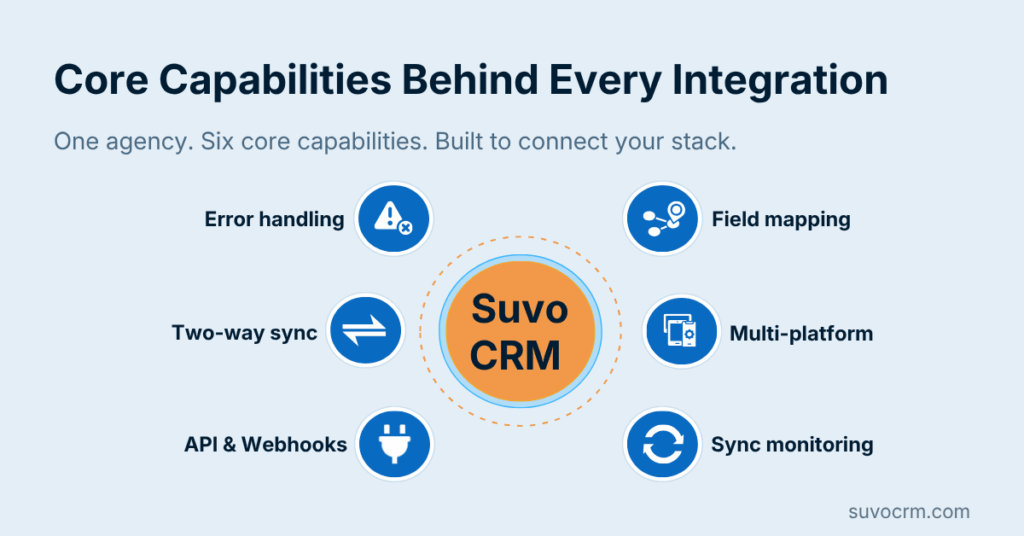
CRM Field API Mapping Services
Most integrations depend on APIs that take specialist work to wire correctly. We connect the CRM to other systems through their REST and webhook endpoints, mapping each field both ways, and lean on CRM development services when an endpoint needs custom code behind it.
CRM Order ERP Linking Services
Your finance and operations data belongs in the CRM where reps can see it. We link the CRM to NetSuite, SAP, or your ERP so orders, invoices, and inventory flow over, and shape the matching objects through CRM customization services where the schema needs reworking.
CRM Email Integration Services
Conversations buried inside scattered inboxes rarely reach the customer record on their own. We sync email, calendar, and outreach activity into the CRM so each touch is logged, and route repeatable sends through CRM automation services for sequences and follow-up.
CRM Merge Integration Services
Two systems holding one shared contact drift apart unless something keeps them honest. We set the sync rules, conflict handling, and deduplication that keep records consistent from tool to tool, backed by CRM data cleansing services so the shared data stays clean.
CRM Middleware Bridge Services
When a dozen or more separate tools each need the CRM, point-to-point links turn into a tangle fast. We build the middleware layer that routes data between them all, then watch each connection through CRM managed services so a single failed job never stalls the whole pipeline.
CRM Integration Watch Services
Connectors age the moment the systems on either end ship updates and change their APIs. We monitor the live integrations, patch what an update breaks, and adjust field mappings as needs shift, the heart of our CRM maintenance services for connections in production.
CRM Integration Tailored to Your Industry
What feeds the CRM changes with the sector. Finance teams sync billing and compliance systems under tight audit rules, while healthcare connects patient and consent records behind stricter access. Retail and manufacturing pipe order, inventory, and ERP data over instead. We have connected CRMs for clients in more than 12 industries.
Common CRM Integration Problems We Solve
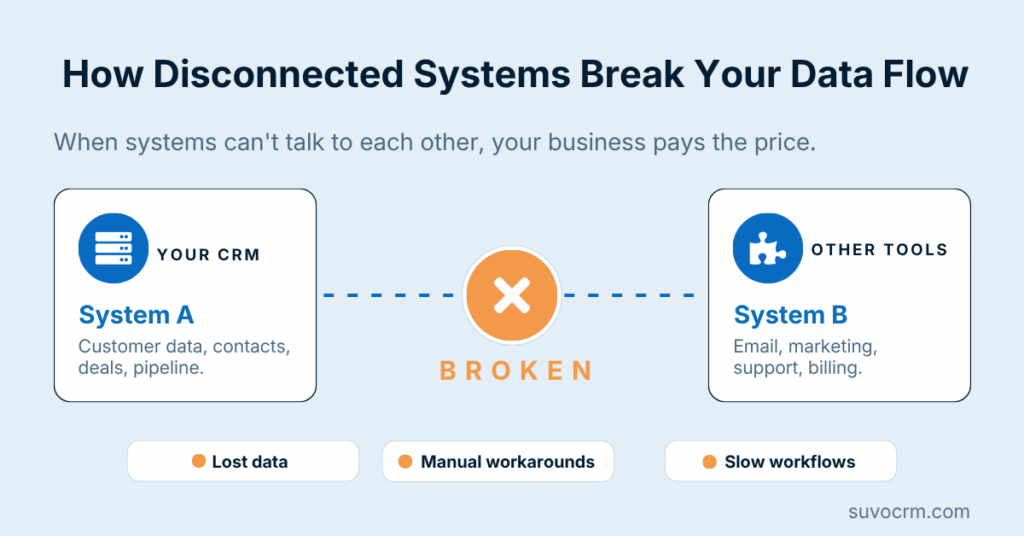
Systems That Never Talk to Each Other
Your CRM sits blind to the ERP, billing, and support tools your team works in all day long. We build the connectors that move data between them, so a single rep sees the full customer picture without opening five other tabs to piece it together.
Manual Exports That Drain Hours
Someone on the team spends hours each week pulling reports from one system to paste into another. We automate those handoffs with scheduled syncs, so the data lands where it belongs on its own and your people get those lost hours back for real work.
Records That Conflict Across Tools
The same customer shows one address in the CRM and another in billing, and nobody knows which is right. We set the sync direction and conflict rules that name one master source, so each system reads a single agreed record instead of a clashing copy.
Connectors That Break Without Warning
An off-the-shelf connector fails silently after a platform update, and data simply stops moving for days. We monitor each live link and alert on failures fast, so a broken sync gets caught and fixed before it corrupts a forecast or drops a real lead.
ERP and Finance Data Sync
Reps lack the full picture when order and invoice data live only in the ERP. We connect the CRM to your finance system so deals, payments, and inventory show up against each account, giving reps the revenue picture without an export or a call to finance.
Email and Calendar Capture
Customer conversations vanish from the record the moment they stay in someone’s inbox. We sync email and calendar activity into the CRM, so each message, meeting, and reply attaches to the right contact and the next rep picks up where the last one left off.
Support and Ticketing Links
A sales rep should never call an account that has an open support ticket. We connect your help desk to the CRM so tickets, status, and history sit on the account, and the whole team works from one shared view of how that customer is really doing.
Marketing and Warehouse Pipes
Leads stall when marketing tools and the CRM hold separate, half-matching lists. We pipe campaign activity and form fills into the CRM and feed clean records out to your data warehouse, so scoring, attribution, and reporting all draw from the same numbers.
Key CRM Connections We Build and Maintain
Why Choose SuvoCRM for CRM Integration
Integration Is Daily Work Here
Our 30 CRM specialists have spent much of their careers wiring CRMs into ERPs, billing, and support stacks. The connection you need has likely been built here before.
Connections We Stay Behind
More than 200 CRM projects have run through our team, and we go on watching the links we build. An integration is something we maintain, not a job we ship once and forget.
No Vendor Pulling the Strings
No software company holds a stake in our agency, so the tools we connect to your stack. We integrate the major platforms and niche, industry-specific systems with equal care.
AI Fed by Connected Data
Smart scoring and prediction need data drawn from the whole stack, not just the CRM. We connect those sources first, so the AI you add learns from a full picture, not a partial one.
How Much Do CRM Integration Services Cost?
Most CRM integration work runs between $4,000 and $25,000, set by how many systems you connect and how cleanly their APIs behave. We price each project to the actual connections it needs rather than dropping you into a fixed tier.
A single well-documented connector, say email or one billing tool, often lands in the $4,000 to $9,000 range. A multi-system build with a middleware layer, custom field mapping, and two-way syncs spanning several tools reaches the top of the band, since each extra system adds its own quirks and failure points to handle.
Because integrations need upkeep, we also run monthly maintenance from around $1,000 that monitors the live links and fixes what platform updates break. Each quote is written down before any work starts. Get in touch for a figure matched to your stack.
How Our CRM Integration Process Works
Step 1: Map
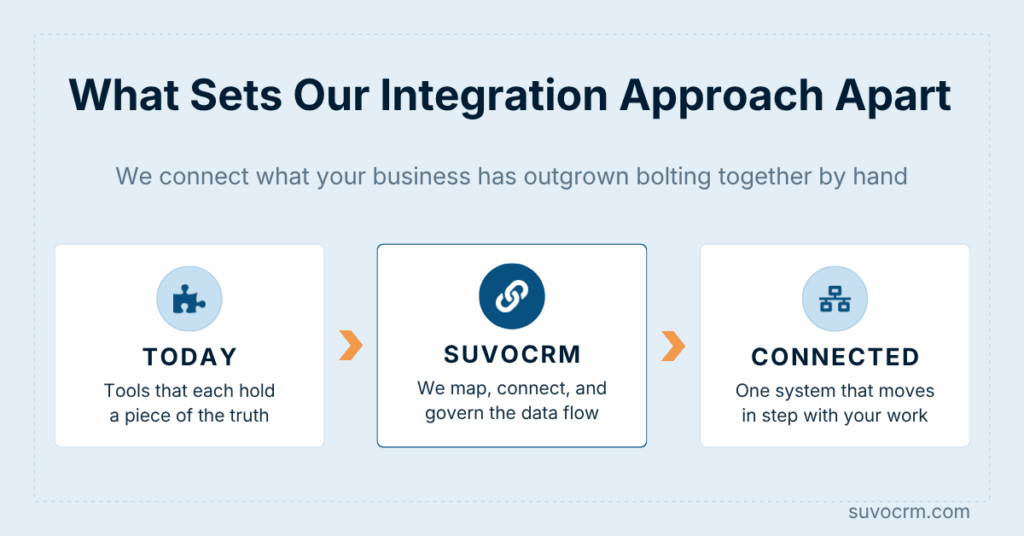
We chart every system that should feed the CRM and the exact data each one owns. Our specialists agree on the fields, direction, and sync rules with you first, so nothing moves on a guess.
Step 2: Connect
Next, we build the connectors and APIs that link each system to the CRM. Each one is wired against documented endpoints, so the link holds steady when a platform ships its next update.
Step 3: Sync
Then we run the data over in stages and check that both ends match. You confirm the records line up before a sync goes live, so nothing overwrites good data in your system unannounced.
Step 4: Watch
Last, we monitor each live link and alert on any failure fast. Our team patches what an update breaks and tunes the mappings month after month, so the connections keep moving data for good.
What Is the ROI of CRM Integration?
CRM integration pays back first in terms of time, nobody spends copying data between systems anymore. Every manual export you retire is an hour handed back to the team that used to run it.
Across our projects, connecting the main systems typically saves each rep 3 to 5 hours a week that used to go to manual lookups and re-entry. That time moves straight back into selling and customer work.
The bigger gain is trust in the data. Once the syncs run clean, conflicting records between tools drop to a fraction of what they were, so forecasts and reports finally agree. Reach out, and we will estimate the return for your own stack.
What Our Clients Achieve
One Customer Record Across Every Tool
Each system reads one shared account, so nobody reconciles conflicting copies by hand.
An End to Manual Data Exports
Scheduled syncs move the data on their own, handing back the hours that exports used to eat.
Sales That Sees Finance and Support
Orders, invoices, and tickets show on the account, so reps work from the full picture.
Connections That Get Caught When They Break
Live monitoring flags a failed sync fast, before it corrupts a forecast or a lead.
Reports That Finally Agree
Every report draws from one synced source, so the numbers stop contradicting each other.
A Stack That Grows Without New Silos
New tools plug into the middleware layer, so adding one does not mean another data island.
How to Get Started with CRM Integration
No integration diagram needs drawing up before you reach us. Drop the systems that refuse to talk to your CRM into the contact field below, and we’ll take it from there.
What follows is a plain conversation about which tools hold your data today and where the gaps cost you time. Expect specific questions from us, a clear read on your current connections, and a shared view of what a fully synced stack looks like for your team.
The plan we shape then fits the budget and timeline you give us, with the connectors and deliverables spelled out in writing before you commit a dollar. Our specialists serve clients throughout the United States, Europe, and Asia. Send us the systems that need connecting, and we will dig in.